
Choose a Montgomery County People Search Route
Start from the strongest fact already known. A full name fits Maryland Judiciary Case Search, the statewide probate index, Business Express, and profession-specific license databases. An address fits SDAT property data, AccessMyAddress, deed references, and permit systems. A school, agency, or college connection points instead to an official staff directory. A date or family relationship is more useful in vital, obituary, cemetery, newspaper, and probate collections.
Spelling matters in a county where compound surnames, transliteration, and address changes are common. Use exact identity details for the voter self-lookup, but try prefixes and spelling variants where court and license tools permit them. Compare dates, middle names, addresses, and document references before concluding that two entries describe the same person.
- Write down the exact name, alternate spelling, date range, former address, and known organization.
- Search the official court, probate, business, or directory source that accepts the clue you have.
- When an address appears, use SDAT to obtain the parcel and deed reference, then follow it into MDLandRec.
- For a deceased person or family line, connect probate with newspapers, cemetery cards, wills, and historical deeds.
- If the index stops short, use a courthouse kiosk, archives collection, library holding, or a focused MPIA request.
Who Keeps Montgomery County People Records?
There is no single county clerk database. The Clerk of the Circuit Court records deeds and handles court files, marriage and business licenses, and notary commissions. The Register of Wills keeps probate estates. Maryland SDAT maintains assessments, while county Finance handles transfer and tax functions. County departments and the 19 municipalities may separately hold permits, police, code, and administrative records. The Montgomery County public records guide explains the request channels and access rules in detail.
Clerk of the Circuit Court
50 Maryland Avenue
Rockville, MD 20850
240-777-9400
Montgomery County MPIA
101 Monroe Street
Rockville, MD 20850
311 or 240-777-0311
Turn a Name into a 1777 Deed Trail
Montgomery County land records begin in July 1777. A free account at MDLandRec opens the statewide grantor-grantee index and document images. Search a surname as both grantor, the person conveying an interest, and grantee, the person receiving one. Names on deeds can include spouses, trustees, personal representatives, lenders, and prior owners, so the instrument role and date matter as much as the hit.
The MDLandRec screen shown below is the official starting point for following a liber-and-folio citation into recorded instruments.
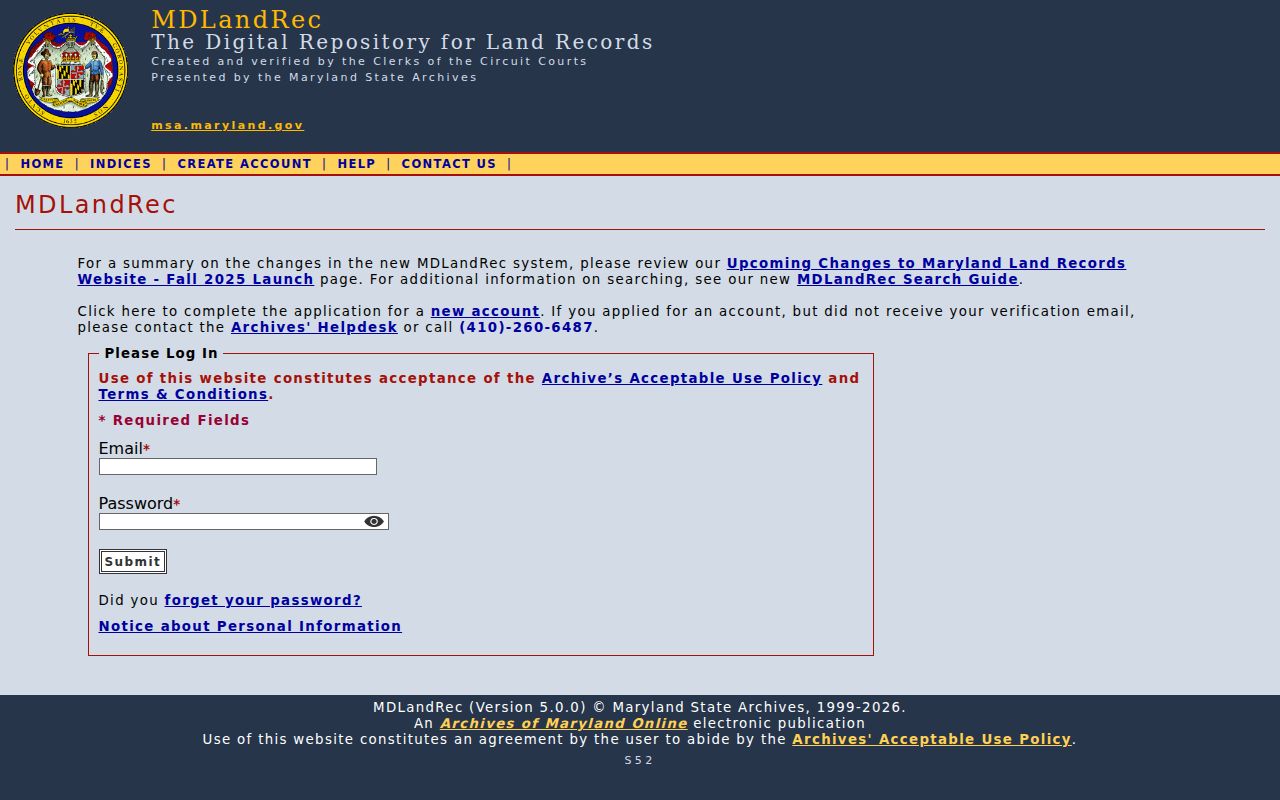
When the modern index is incomplete, use the Circuit Court public room or Maryland State Archives. Retired Equity Index Books cover 1777–1981, an MSA land index covers 1851–1927, and microfilm duplicates extend from 1853 to 1993.
Liber and folio: the book-and-page reference that identifies a recorded deed or related instrument.
Why an Owner Name Will Not Start the Property Search
Maryland SDAT Real Property Data Search does not offer owner-name searching. Begin with a street address, account identifier, map and parcel, or property-sale criteria. The result can reveal owner and mailing names, premises address, deed reference, legal description, transfer history, values, structure facts, subdivision details, and exemption indicators.
| Known clue | Use first | Next connection |
|---|---|---|
| Street address | SDAT property search | Open the deed liber/folio in MDLandRec |
| Parcel or account | SDAT identifier search | Compare owner mailing and premises addresses |
| Only an owner name | Court, business, deed, or license index | Carry a discovered address into SDAT |
A mailing address is correspondence information, not proof that an owner lives at the parcel. Ownership, principal-residence, and homestead indicators each answer different questions and should be checked against dated records.
Search Montgomery County Court Records by Name
Maryland Judiciary Case Search provides public docket summaries for District Court of Maryland District 6 and the Circuit Court for Montgomery County. Search by party name and narrow with court, case type, date, or case number where available. A result may show parties, filing events, charges or claims, disposition, hearing information, and docket entries, but the clerk's file remains the official record.
Sealed and expunged matters, juvenile cases, adoption records, and other confidential material do not become public because a name is known. For a public case omitted or unclear online, inspect the courthouse kiosk, ask the clerk to view the file, or submit the Circuit Court copy-request form. Federal District of Maryland matters use PACER.
| Court | Covers | Name Search | Access |
|---|---|---|---|
| District Court, District 6 | Public district civil, criminal and traffic dockets | Maryland Judiciary Case Search | Online summary; clerk fallback |
| Circuit Court | Public circuit civil and criminal matters | Maryland Judiciary Case Search | Online summary, kiosk, file request |
| U.S. District Court, District of Maryland | Federal cases | PACER | Account-based federal access |
Find Montgomery County Vital Records
Montgomery County HHS Vital Records on Dennis Avenue issues recent Maryland birth and death certificates. The Maryland Division of Vital Records supplies statewide certificates and verifications. Marriage licenses and divorce decrees belong with the Circuit Court. Certified-copy eligibility follows Health-General §4-217; these are not open resident directories.
State Government §9-1015 restricts births under 100 years old and deaths under 10 years old. Older births and deaths move into the historical-access side of the Maryland State Archives, alongside marriage licenses and reports of absolute divorce or annulment. For genealogy, verify the event, jurisdiction, and approximate year before ordering, since a marriage license, decree, certificate, and index entry are different records.
Connect an Estate Search to Heirs and Property
The Maryland Register of Wills estate search is a strong name-first source for a deceased person. It identifies estates handled through the Orphans' Court and Register of Wills system; the local file can then connect a decedent with a personal representative, interested persons, dates, and estate proceedings. Search spelling variants and a sensible death-year range.
The official estate-search interface below helps establish the file reference before requesting or reviewing local probate material.
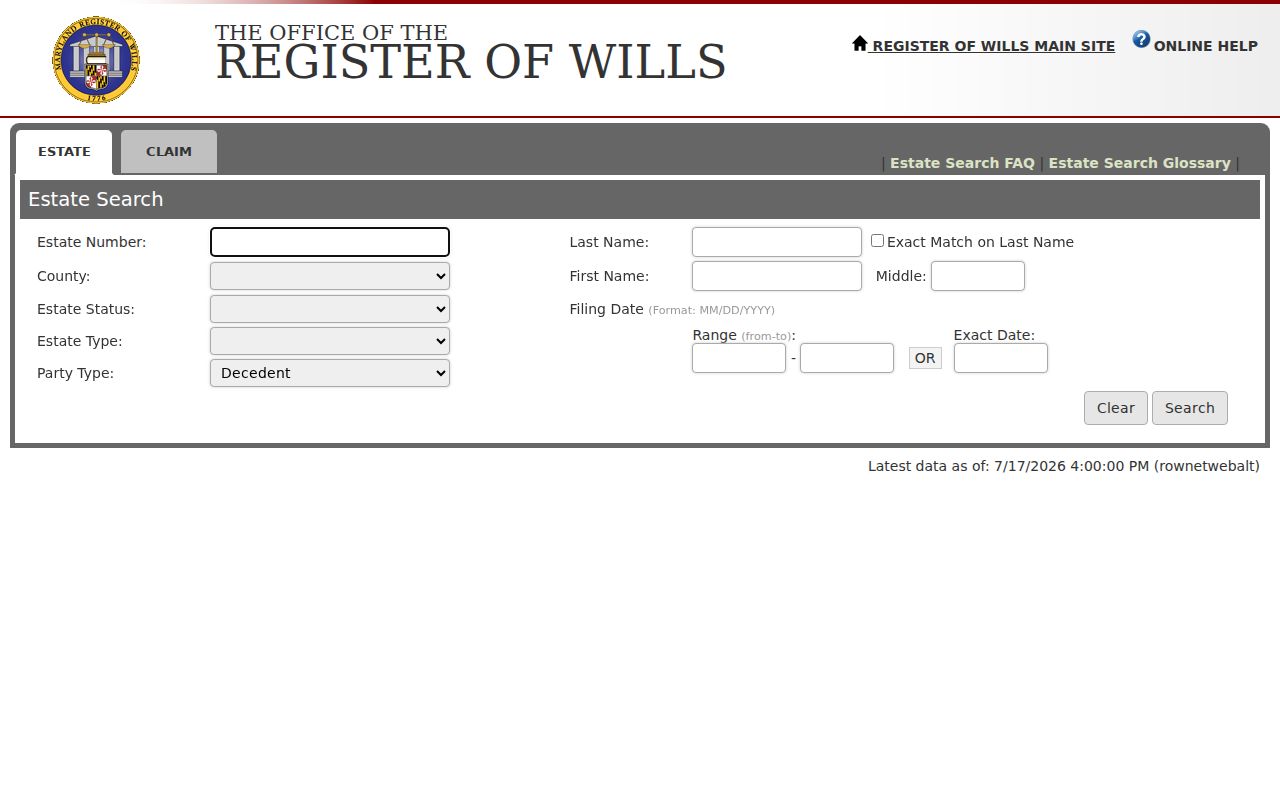
For an heir search, compare the probate file with deed and tax references rather than assuming that an interested person inherited a particular parcel. Obituaries and newspapers can add family context but do not replace the filed estate record.
Use Business Records as a Name-and-Address Bridge
Maryland Business Express Entity Search accepts a business name, Department ID, or EIN in the displayed format. Entity results may provide the legal name, status, resident agent, principal office, and filing references. A resident agent accepts legal process; the role does not establish ownership or residence.
The official search screen illustrates the three ways to identify an entity before checking its filings or local licenses.
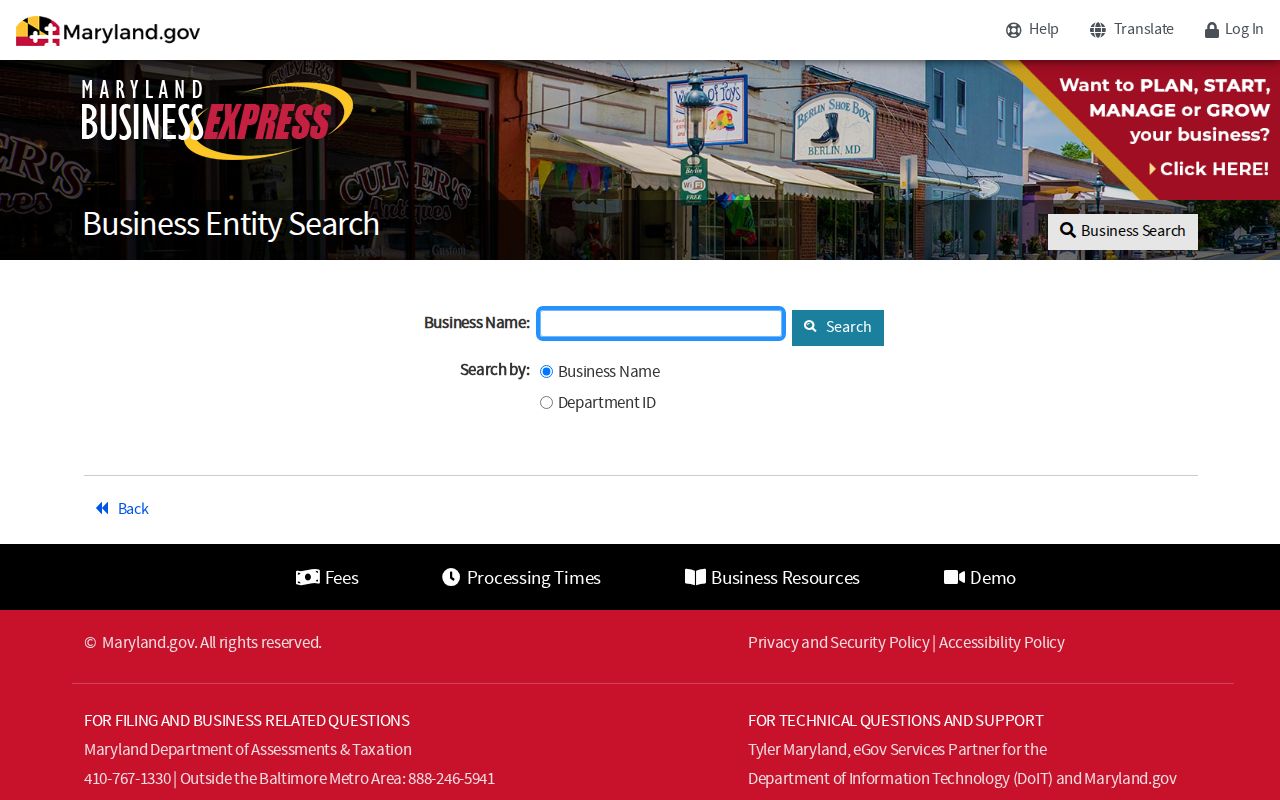
For regulated occupations, move to the relevant Maryland board because there is no single complete professional database. Circuit Court business licenses and county or municipal permits can provide a separate local trail.
A Mailing City Does Not Set the Records Custodian
Roughly one-third of county residents live in incorporated municipalities, and Montgomery County identifies 19 municipalities. Rockville, Gaithersburg, Takoma Park, and Poolesville maintain responsibilities that can differ from county systems; Bethesda and Silver Spring are not incorporated cities. That distinction affects permits, code files, police records, and address administration.
AccessMyAddress accepts a full or partial address, resolves suggestions, and reports service areas, schools, election districts, and planning geography. Its Postal City and Unincorporated Community attributes help prevent a mailing label from being mistaken for legal jurisdiction.
The county GIS interface shown here is useful for routing a request to the right custodian, not for proving that a named person resides at an address.
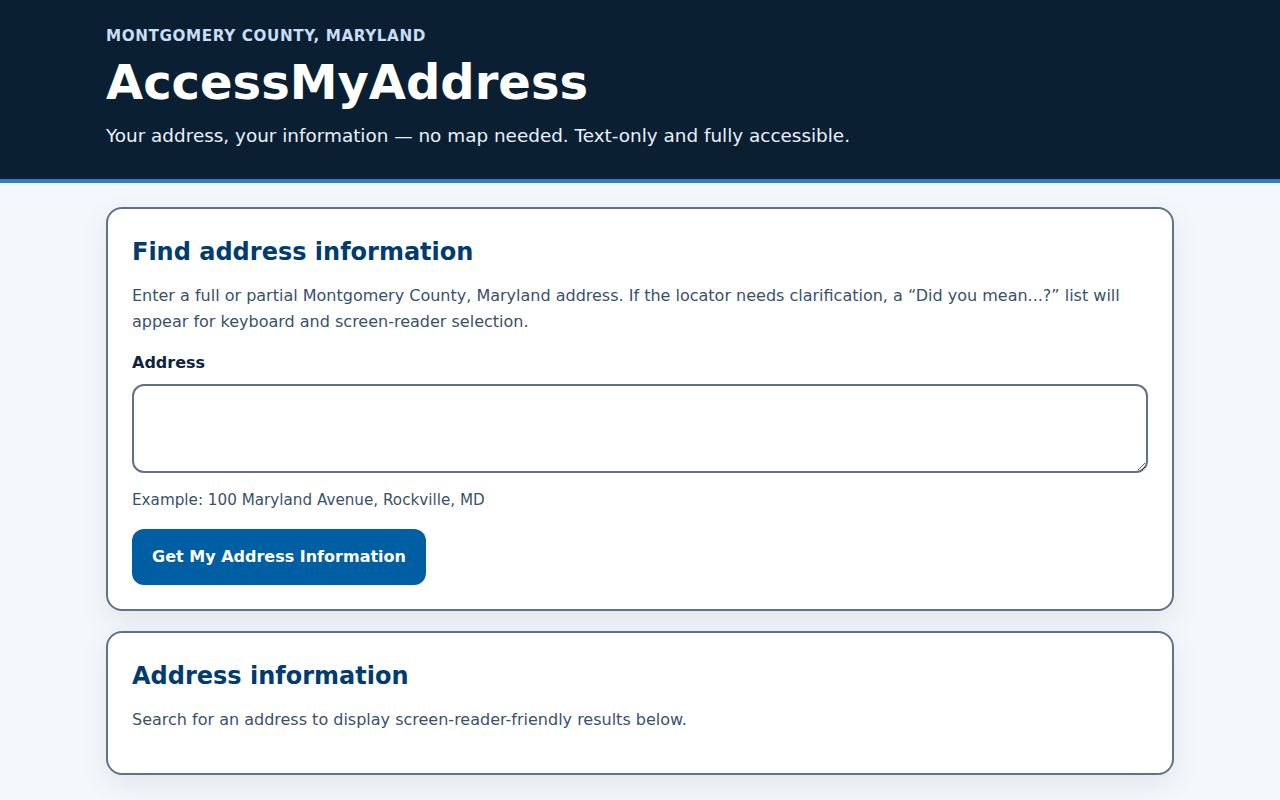
County DPS permit coverage generally begins October 17, 1986, with some well and septic material back to 1943, and excludes Rockville and Gaithersburg. If a county search fails, identify the municipality before assuming no record exists.
Montgomery County Directories Cover Workplaces, Not Households
Official directories answer focused affiliation questions. The county employee phone book searches current staff by first name, last name, and department. MCPS offers staff, school, office, keyword, location-code, and organizational searches. Montgomery College profiles may list title, program, email, phone, campus, room, education, and biography. Browse the distinct sources on the Montgomery County directories page.
No authoritative public countywide residential white pages, alumni list, or complete reverse-directory run was verified. A staff listing is a workplace contact, and a property owner is not necessarily an occupant. Keeping those categories separate prevents a directory result from becoming an unsupported residence claim.
Follow Montgomery Families Beyond Modern Portals
Montgomery History and the Jane C. Sween Research Library bridge the gaps left by current databases. Sween abstracts cover wills, marriages, land, tax, and census material across mixed years from 1776 to 1900. Montgomery History catalogs more than 1,100 archival collections or items and over 14,000 photographs; its resources include searchable catalogs, yearbooks, newspapers, cemetery cards, family files, and community histories.
The deeper trail includes land books from 1777, wills from 1776, plats from 1783, taxes from 1793, and marriage abstracts from 1798. Newspaper runs include the Sentinel from 1855–2020 and Gazette material from 1960–2015, while cemetery cards document 111 sites surveyed in the 1970s. The Lincoln Park History Project adds biographies and family links for a Rockville African American community founded in the 1890s.
These collections overlap deliberately. FamilySearch filmed courthouse manuscripts in 1948, the State Archives retains retired indexes and microfilm, and Sween researchers created abstracts that can point back to an original record. A useful method is to record the archive call number, catalog title, date span, and every spelling exactly as displayed, then compare that lead with the courthouse instrument or estate file. Historical abstracts and index cards shorten the search, but the underlying document supplies the context that an extracted name cannot.
Search insight: Use community, school, church, newspaper, and land context together; never infer a person's ethnicity from a surname.
Use Voter Records Within Maryland's Narrow Rules
The Maryland SBE Voter Search is a daily-updated self-service lookup that requires first name, last name, date of birth, and five-digit ZIP code; street number and middle initial are optional. It can return a person's own registration, polling place, districts, local board, mail or provisional status, and sample ballot. A failed match is not proof that someone is unregistered, and the tool is not a browseable people directory.
Election Law §3-506 limits voter-list copies to a Maryland registered voter who files a written application and sworn electoral-purpose statement. Commercial solicitation, non-electoral use, resale, and transfer are forbidden, and protected-voter residence is withheld. The Montgomery County voter registration page explains state and county products, fees, timing, and Safe at Home protections.
Safe at Home gives an eligible survivor a substitute legal post-office-box address and mail forwarding. Government offices generally must accept that substitute, and election records suppress a participant's residence. Respecting those protections is part of reading an official result correctly: an omitted address may reflect law and personal safety, not a defective search.
When a Montgomery County Search Reaches a Dead End
First confirm that the correct office, spelling, date range, and jurisdiction were used. Then switch channels: a Circuit Court public kiosk for case or land material, the clerk's copy form for a known case, an assessment-office inquiry for a parcel, the Maryland State Archives for older records, or Montgomery History for local collections. No verified live county jail roster exists; use local correctional contacts or VINE rather than relabeling the state DPSCS locator.
For an existing government record not otherwise available, send a focused request under the Maryland Public Information Act, General Provisions Title 4. Identify the custodian, record type, names or addresses, date span, preferred format, and willingness to narrow. Agencies do not have to create a custom record. The first two preparation hours are free; other reasonable production costs may apply. Readily available material may be produced immediately, while other requests receive notice within ten days and a response within no more than 30 days.
Ask for the record as the office keeps it rather than asking the agency to research a person or answer a broad question. For example, identify a case number and docket range, a deed liber and folio, a parcel account, or a dated permit file. If a request is denied, delayed, or priced unexpectedly, narrowing it can be faster than beginning again. Maryland's Public Access Ombudsman, the State Public Information Act Compliance Board, and judicial review provide dispute routes described in the public-records material.
Keep a search log with the portal name, query spelling, filters, date searched, result identifier, and next custodian. That small record makes it easier to distinguish a true gap from a spelling failure, a restricted record, or a database that covers only later years. It also prevents an undated screenshot or copied address from being mistaken for a current official finding.
Commercial people-finder results can be stale, conflated, or incomplete. Use them, if encountered, only as unverified leads and return to the official custodian before relying on a record. Maryland's Online Data Privacy Act, effective October 1, 2025, supplies rights over covered commercial data but excludes publicly available information; it is not a mechanism for erasing courthouse or land records.