
Check Montgomery County Voter Registration
The Maryland State Board of Elections Voter Search is the first stop for a Montgomery County voter checking a personal record. It is updated daily and supports more than a basic registration check. A voter may request a duplicate registration card, find a polling place and voting districts, locate the local election board, review mail-in or provisional ballot status, and reach a sample ballot. The service validates identity and address facts before returning a result. It does not accept a county name or voter ID as a search key.
| Field | Type | Required | Notes / Format |
|---|---|---|---|
| First Name | Text | Yes | Letters and spaces, up to 30 characters |
| Last Name | Text | Yes | Letters, hyphens, and spaces, up to 30 characters |
| Date of Birth | Month, day, year | Yes | Enter as MM/DD/YYYY |
| ZIP Code | Text | Yes | Exactly five digits |
| Street Number | Text | No | Use the registered residential number |
| Middle Initial | Text | No | One letter |
The form offers Search and Clear buttons. Its exact facts make it a self-service lookup, not a way to browse Montgomery County voter rolls by surname or street. This boundary matters. Anyone seeking a qualified voter-list product must use the separate state or county application route described below.
Use the registered residence facts, even when a postal address is written a different way elsewhere. Street Number is optional, but the required name, birth date, and five-digit ZIP still have to match the election record closely. Middle Initial can help narrow the identity match. Because the page has no county selector, Montgomery County is established through the matched registration rather than chosen as a filter.
The live Maryland lookup appears in the captured official voter-search source shown here.
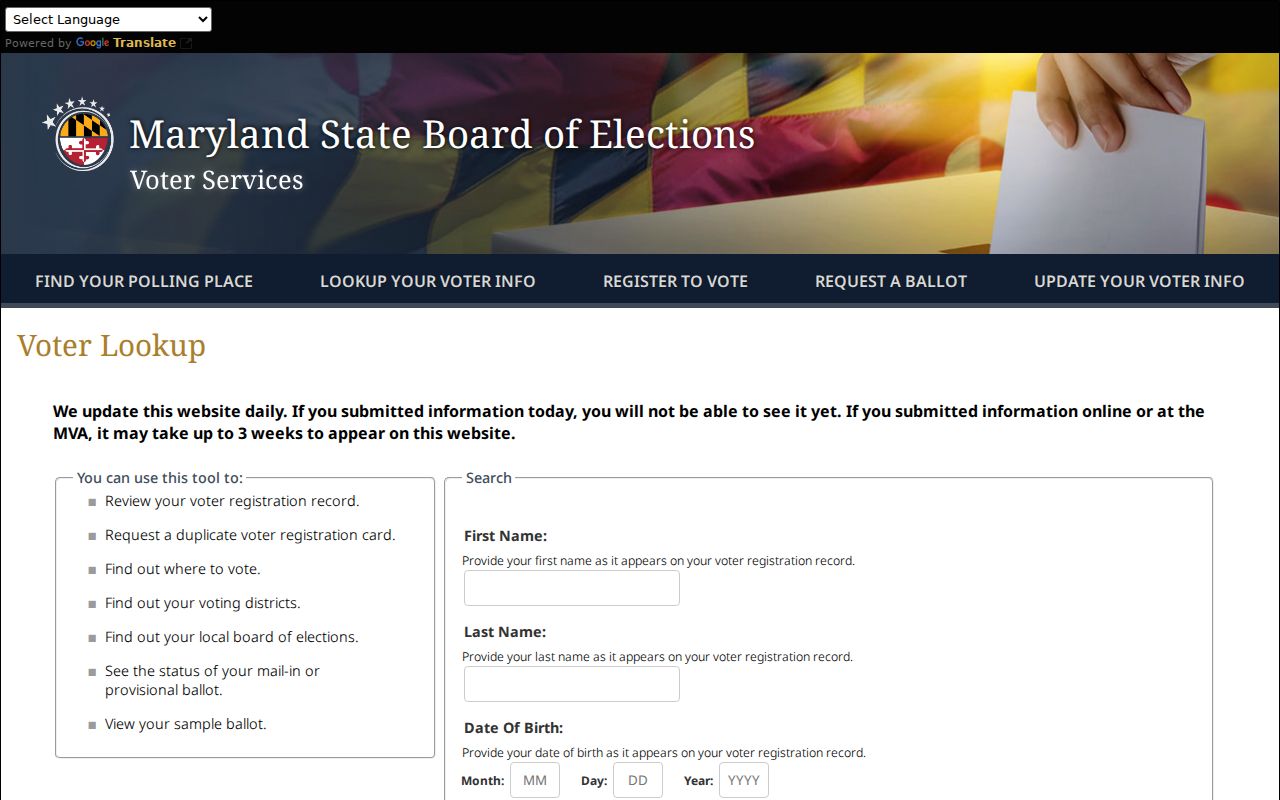
The screenshot reinforces the identity gate: a voter must supply matching personal fields before the service reveals registration services.
Montgomery County Lookup No-Match Tips
A missing result does not prove that a person is unregistered. First enter the name exactly as it appears on the voter record, not a nickname. After a recent move, try the former ZIP code. After a name change, try the prior registered name. Online and Motor Vehicle Administration changes may take up to three weeks to appear, and same-day submissions are not shown.
If those checks fail, contact the Montgomery County Board of Elections rather than drawing a broad conclusion. Staff can help a voter resolve a record under the office's identity and disclosure rules. The safest reading of any no-match is narrow: the submitted values did not produce a record at that time.
A recent move can create two separate timing issues. The voter may remember the new ZIP while the old ZIP still remains on the registration, or an online change may still be pending. A recent name change creates the same kind of mismatch. Try each documented former value on its own, keep the date of any submitted update, and give that detail to local election staff if direct help is needed.
Note: Voter Search is refreshed daily, but recently filed registration changes may still be moving through the election system.
Montgomery County Voter Lookup Results
A successful voter registration lookup provides services tied to the verified voter. These can include the registration record, polling place, voting districts, local-board contact, duplicate registration card, sample ballot, and mail-in or provisional ballot status. The result is useful for the voter's own election planning. It is not a certified record and does not expose the full state voter database.
The distinction also guards against a common myth. Maryland does permit qualified access to specified voter-list products, yet the public-facing search box is not an open roll. The lookup and the purchased file have different users, fields, and legal tests.
A registration card and a voter-list export also serve different needs. The duplicate card confirms the voter's own registration details. Polling and district results help that voter prepare for an election. A full export, by contrast, is a structured election product released only after the applicant meets Maryland's access test. One result should never be treated as a substitute for the other.
Lookup versus voter file. The lookup verifies one voter through exact facts. A list requires an application, sworn purpose, payment where applicable, and compliance with Election Law §3-506.
Fields in Maryland Voter Records
The registered-voter list has a wider schema than self-service Voter Search. It can contain voter ID, parsed and full name, party, gender, residential and mailing addresses, active or inactive status, state and county registration dates, precinct, and several district assignments. Those assignments can include congressional, legislative, councilmanic, ward, municipal, and commissioner districts, plus the county. Access to that released file remains purpose-restricted.
| Identity | Voter ID, parsed name, and full name |
|---|---|
| Addresses | Residential and mailing addresses, except protected residence data |
| Registration | Party, gender, status, and state and county registration dates |
| Election geography | Precinct, split, county, and assigned political districts |
| Voting history | Participation details, never the candidate or ballot selection |
Confidential by law. Released voter schemas omit Social Security numbers, motor-vehicle or identity credentials, signatures, and full birth dates. Election Law §3-506 also withholds a Safe at Home participant's residence unless a separate SBE process applies.
These are released-product fields, not a claim that every internal election-system field is public. Maryland's voter-list disclosure statute controls the eligibility, sworn purpose, and protected-address limits.
Montgomery County Elections Office Channels
The Montgomery County Board of Elections is the local custodian for county registration help and county voter products. Its public office is at 18753 North Frederick Avenue, Suite 210, Gaithersburg, Maryland. The mailing address is PO Box 4333, Rockville, MD 20849-4333. Posted weekday hours are 8:30 a.m. to 5 p.m. The main phone is 240-777-8500.
Registration Help
Call 240-777-8500 when an exact-name, former-ZIP, and former-name check still produces no match.
Registry Form Delivery
Email voter.registration@montgomerycountymd.gov, fax 240-777-8600, or mail the completed viewing form.
These channels are alternatives, not duplicates. Voter Search serves a resident checking a personal registration. The registry-viewing form handles a county election-record request under its own rules. Phone contact is best for resolving a failed self-lookup, while email, fax, and mail create a documented request path for the applicable county product. The public counter gives voters an in-person route during posted hours.
Montgomery County Voting History Limits
Voting history shows participation, not how anyone voted. An included history can add one column per election to a restructured registered list, with a maximum of five elections in that combined state product. It does not provide voting method or date. A separate history file can cover up to ten elections and may include voter ID, election date and description, election type and code, party, voting method and date, precinct, early-vote location, jurisdiction code, and county.
Both formats can be linked through voter ID, but neither reveals a candidate choice, ballot question choice, or marked ballot. Maryland also says voter data may not be used to investigate suspected illegality or a person's behavior in an election. Participation data must not be recast as proof of a vote for any person or cause.
The choice between included and separate history affects how the data can be read. Included history makes a compact set of election columns easy to compare with registration fields. Separate history preserves more event detail and can span more elections, but users must join it to the registered list by voter ID. Either way, election participation is an administrative event record. It is not a record of political preference.
Date, method, precinct, and early-vote location fields can describe how an election system processed participation. They still do not identify the contents of a ballot. Even a precise history row cannot support an inference about a candidate, referendum, or issue choice. That limit applies to Montgomery County records just as it does to the statewide file.
Request Maryland Voter Registration Files
Election Law §3-506 uses a two-part access test. An applicant must be a registered Maryland voter and must swear that the requested information will serve an electoral purpose. The current State Board of Elections voter-list instructions identify permitted election uses such as registration drives, party formation, candidate qualification, petitions, elections and recounts, ballot processes, and campaign finance. One application covers one list.
- Complete the state application with personal contact and residential details. Add organization details when relevant, describe the intended use, and choose one region and list.
- Select statewide, county, or district coverage, then choose applicable election years and limits. Options can narrow the file to active voters, a registration-date range, selected parties, or all registered voters including inactive status.
- Sign the oath and arrange payment. Statewide data costs $125; one county or one district costs $75. FTP delivery has no media fee, while a flash drive adds $15.
Payment may be made by credit card, certified, personal, or campaign check, or money order payable to SBE. A returned check brings a $30 fee. The state lists 410-269-2840 and dlPSR_sbe@maryland.gov for product questions. Once a complete application and payment arrive, delivery is due within ten working days. Before an election, SBE must receive the request by the advanced-registration deadline, 21 days before Election Day. Later requests are returned until the election has passed.
The form asks for the applicant's name, best phone number, residential address, city, state, and ZIP code. If an organization is involved, it also requests the entity name, contact, address, and phone. A narrative must state how the information will be used. Region choices are statewide, one named county or Baltimore City, or one district with its type and number. The inspected form lists gubernatorial and presidential primary and general elections from 2026 back through 2006.
Knowing misuse is a misdemeanor. The application states a penalty of 30 days to six months, a fine up to $250, or both. It forbids commercial solicitation, non-electoral use, sale, distribution, and transfer of the data.
Montgomery County Voter List Products
The Montgomery County Board of Elections product page offers a local route alongside the state file. A registry-viewing form may be emailed to voter.registration@montgomerycountymd.gov, faxed to 240-777-8600, or mailed. The office also publishes countywide file instructions and a readme. Polling-place lists are online, with a $1.50 hard-copy option.
Local product prices are not the same as state media charges. Montgomery County's permanent-mail-in file is free by email or $10 on USB. Its posted cadence is monthly in non-election years, twice monthly during election years until six weeks before an election, then weekly. The received-mail-in product is likewise free by email or $10 on USB and is released on posted Fridays.
The county's voter product page is visible in the second successful research capture.
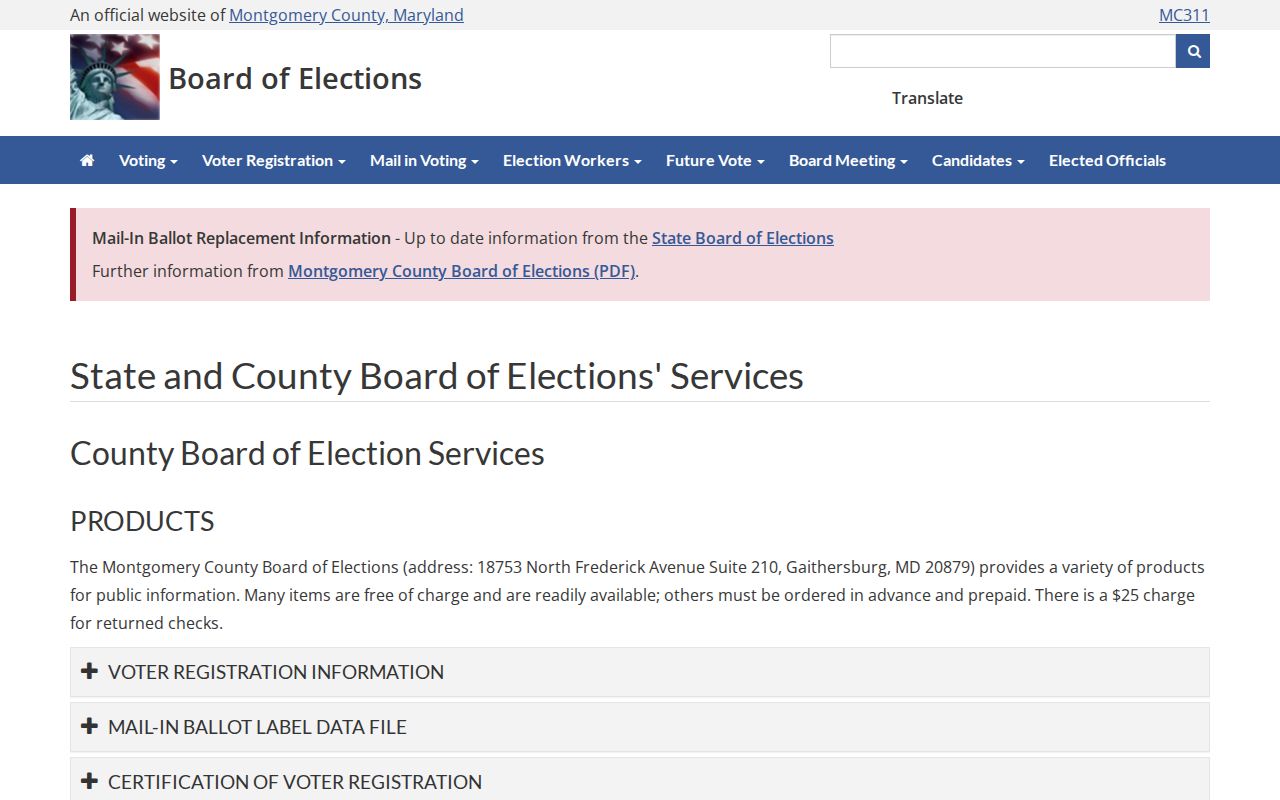
The image points readers to the official county instructions, where file descriptions and current release notices belong.
Note: State flash media costs $15, while specified Montgomery County USB products cost $10; email delivery can be free.
Maryland Voter Roll Product Choices
The June 30, 2026 state application documents more than a registered-voter list. Choices include a walking list, permanent mail-in applicant data, mail-in data for one election, provisional data, early-voting data, cure data, and voting history. A walking list is not offered statewide. It sorts by precinct and street, groups voters at an address, places even addresses on one side and odd addresses on the other, and includes party.
Mail-in products may show voter identity, residence, mailing or ballot addresses, precinct and districts, registration dates, party, request type, status, and county. Early-voting data can add location, date, ballot style, and gender. Provisional data can add status and reason, county and precinct voted, ballot-issue reason, and ballot styles required or voted. Cure data tracks old and new statuses or reasons, source, envelope type, and change date. Each product remains bound to the sworn election purpose.
A requester should choose the narrow product that matches the approved electoral task. The registered list is the broad roster. A permanent-mail-in applicant file concerns standing mail-ballot status, while a single-election mail-in file concerns one event. Provisional, early-voting, and cure files capture distinct steps in election administration. Combining those labels or treating them as one general resident database would erase the differences built into the application and schemas.
Protected Montgomery County Voter Addresses
Maryland's Safe at Home Address Confidentiality Program supplies an eligible participant with a substitute legal address and forwards first-class, certified, and registered mail plus service of process without charge. It serves qualifying survivors and certain household members whose actual address should remain unknown to an abuser. Enrollment goes through a trained Application Assistant and requires supporting documentation.
Government offices generally must accept the substitute address unless a legal exception or approved waiver applies. The program says actual-address disclosure requires a court order. Within voter records, the protected residence is excluded unless a separate State Board of Elections application applies. This is a firm limit, not a search obstacle to work around.
Qualifying proof can include certified police, court, or government records; material from a domestic-violence program; or documentation from a religious, medical, or other professional source. The program is designed for Maryland residents who recently moved or plan to move to an address unknown to an abuser. Its protections can extend to certain family or household members.
Montgomery County Rolls Across Time
Current list maintenance follows federal and state rules. The State Board of Elections states that failure to vote alone cannot remove a voter. Active and inactive status fields therefore require care: neither one, by itself, tells the full story of a person's registration activity or residence.
For historical research, Maryland State Archives Series C3362 confirms that Montgomery County voter-registration records survive outside the current election tools. The source review did not establish exact item years, so no continuous date range should be assumed. Researchers should ask the Archives for the series inventory and cite the specific register or poll record returned.
An archive request should name Montgomery County, the C3362 series, the person or precinct of interest, and the best known time period. Ask whether an index, register, poll book, or image is available and whether access is onsite or by copy order. That method preserves the source's actual coverage instead of assigning unsupported dates to the collection.
Older registers serve genealogy and civic history, while the modern identity lookup serves today's voter. Keeping those purposes apart prevents a historic source from being mistaken for a present address directory.